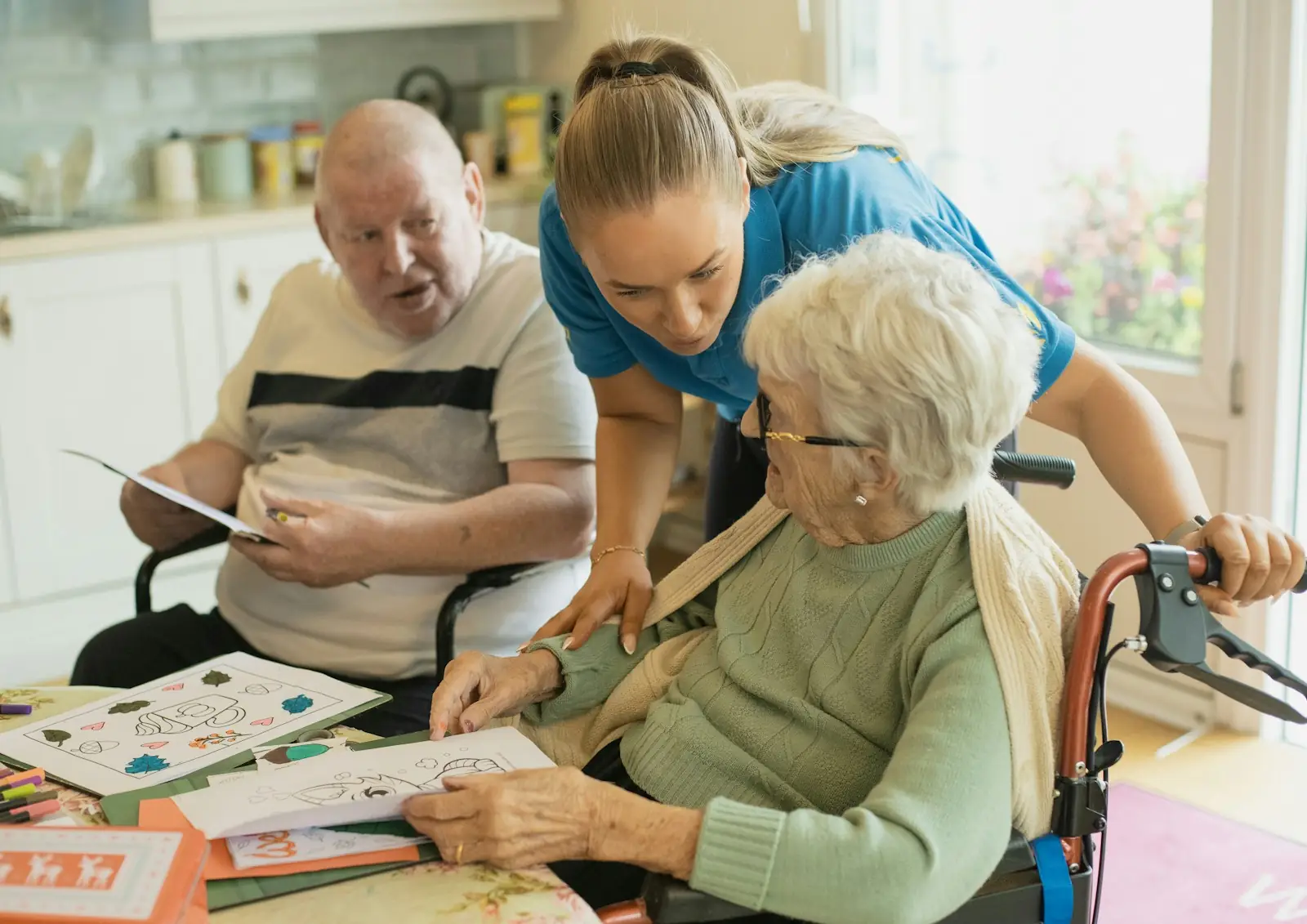
Why use non-drug approaches first?
Antipsychotics offer modest benefit for agitation and aggression in dementia and carry an FDA boxed warning for increased mortality. Federal nursing home rules require behavioral interventions to be part of care for any resident on a psychotropic, and 2025 surveyor guidance says psychotropics may be considered only when non-drug approaches have been attempted (unless contraindicated) and symptoms still cause danger or significant distress. Non-drug care is not an extra; it is the expected first-line treatment. See reducing antipsychotic use for the regulatory detail.
What is the DICE approach?
DICE was published in 2014 by Helen Kales, Laura Gitlin and Constantine Lyketsos on behalf of a multidisciplinary expert panel. It gives teams a structured way to work out why a behavior is happening.
- 1DescribeAsk the caregiver and, where possible, the resident to describe the behavior in detail: what happened, when, where, with whom, and what came before and after. Logging for several days helps.
- 2InvestigateLook for causes: pain, infection, constipation, sleep loss, medication effects, sensory loss, depression, the environment, the care approach and unmet needs.
- 3CreateThe team (including family) builds a plan that targets the cause: treat the pain, change bath time, reduce noise, add a meaningful activity, adjust how staff approach.
- 4EvaluateCheck whether the plan was used and whether it worked. Keep what helped and revise what did not.
Does treating pain reduce agitation in dementia?
Often, yes. People with moderate to severe dementia may not be able to say they hurt, and pain may show up as resistance to care, calling out or aggression. In a 2011 BMJ cluster randomized trial in 60 Norwegian nursing home units, residents with dementia and agitation who received a stepwise pain protocol had about 17% lower agitation scores after eight weeks than controls. Most received only scheduled acetaminophen. Use an observational pain scale such as PAINAD for residents who cannot self-report; our pain assessment tools page compares options, and pain management covers the wider program.
Does music help people with dementia?
Music is pleasurable for many residents and can ease specific moments such as bathing or sundowning. The research picture on reducing agitation is mixed. A large pragmatic trial published in 2022 (54 US nursing homes, 976 residents) found that a personalized music program did not change the overall frequency of agitated behaviors or psychotropic prescribing; the authors cited difficulty engaging frontline staff and identifying each resident's preferred music. Earlier observational studies were more positive. A fair conclusion: use preferred music as part of an individualized plan, time it to known triggers, and judge it person by person rather than expecting a facility-wide effect.
What other non-drug approaches have evidence?
| Approach | What it looks like | Evidence summary |
|---|---|---|
| Person-centered care training plus social interaction | Staff learn to know each resident; short daily one-to-one conversations | WHELD trial (69 UK homes, 2018): better quality of life, less agitation and fewer neuropsychiatric symptoms |
| Structured, individualized activities | Activities matched to past interests and current abilities, including simple helping roles | Several trials show reduced agitation and better engagement; effects depend on tailoring |
| Consistent caregivers | Same aides across shifts | Supports recognition of early changes; endorsed in quality programs |
| Sleep hygiene | Daytime light and activity, limited daytime napping, quiet nights, fewer night disruptions | Improves sleep patterns in some studies; avoids sedative-hypnotic risks |
| Environmental changes | Lower noise, good lighting, clear signage, safe walking paths, quiet rooms | Reasonable evidence for reducing distress, especially noise and glare |
| Caregiver communication skills | Approach from the front, one-step instructions, offer choices, avoid arguing | Core component of most successful programs |
| Exercise and walking | Supervised activity and time outdoors | Improved neuropsychiatric symptoms in the WHELD factorial study |
Consistent assignment deserves special mention. When the same caregivers work with a resident day after day, they learn that resident's signs of pain, fear or fatigue and can act before a crisis. See consistent assignment for how to set it up.
How do you make non-drug care work every day?
- Put it in the care plan. Name the trigger and the specific approach (for example, "bath at 10am after breakfast, warm towels, music from the 1950s").
- Share it at every handoff. Use shift huddles so agency and float staff know what works.
- Assign a champion. The WHELD model trained care-staff champions to coach peers.
- Measure. Track behavior frequency before and after a change, not just whether an activity was offered.
- Involve families. They hold the life history that makes plans personal.
For assessment of specific behaviors see behavioral symptoms of dementia, and for training and audit tools see the professional toolkit. Families can find practical tips in the family guide. Return to the main dementia care guide.
Frequently asked questions
What are non-pharmacological interventions for dementia?
They are care approaches that ease distress without medication: finding and treating causes such as pain or infection, consistent caregivers, individualized activities, calm environments, good sleep routines, music and communication techniques. Federal nursing home guidance expects them to be tried first and continued even when a psychotropic is used, unless clinically contraindicated.
What does DICE stand for in dementia care?
DICE stands for Describe, Investigate, Create and Evaluate. It is a structured method published in 2014 by an expert panel led by Helen Kales, Laura Gitlin and Constantine Lyketsos. Caregivers describe the behavior, the team investigates causes, creates a targeted plan, and evaluates whether it worked.
Can treating pain reduce agitation in dementia?
Yes. In a 2011 BMJ trial in Norwegian nursing homes, residents with dementia and agitation who received a stepwise pain treatment protocol, mostly scheduled acetaminophen, showed about 17% less agitation after eight weeks than those receiving usual care. Pain should be assessed with an observational scale in people who cannot report it.
Does personalized music reduce agitation in nursing home residents?
Not reliably at a facility-wide level. A 2022 trial in 54 US nursing homes found a personalized music program did not change overall agitation or psychotropic use, partly because of implementation challenges. Many individual residents still enjoy and respond to preferred music, so it is worth including as part of a tailored plan.
How can nursing homes improve sleep in residents with dementia?
Practical steps include daytime light exposure and activity, limiting long daytime naps, avoiding caffeine late in the day, treating pain, reducing night-time noise and light, and grouping overnight care tasks to avoid repeated waking. These avoid the fall and confusion risks of sedative sleeping pills.
Get help choosing care or coverage
Talk with a licensed agent about Medicare, Medigap, Medicare Advantage and ways to pay for a nursing home stay. Or call 1-800-MEDIGAP (1-800-633-4427).
Sources
- Kales HC, Gitlin LN, Lyketsos CG. Management of neuropsychiatric symptoms of dementia (DICE). J Am Geriatr Soc 2014
- Husebo BS et al. Pain treatment and agitation in nursing home residents with dementia. BMJ 2011
- Ballard C et al. WHELD cluster-randomised trial in 69 UK nursing homes. PLoS Medicine 2018
- McCreedy EM et al. Pragmatic trial of personalized music in nursing home residents with dementia. JAMDA 2022
- Kales HC et al. Assessment and management of behavioral and psychological symptoms of dementia. BMJ 2015
Medical disclaimer. This page is general education, not medical, legal or financial advice, and it does not replace the judgment of a qualified clinician who knows the resident. Do not start, stop or change any medication without talking to the prescriber. In an emergency, call 911.
Independent resource. NHQualityCampaign.org is an independent educational resource. It is not affiliated with, endorsed by or operated by the Centers for Medicare & Medicaid Services (CMS), the U.S. Department of Health and Human Services (HHS), any government agency, or the original Advancing Excellence in America’s Nursing Homes campaign or its sponsors. Historical campaign information is summarized with attribution for educational purposes.
Related reading
 Dementia careGood dementia care in a nursing home means knowing the person, treating causes of distress, and using…
 Behavioral symptomsBehavioral symptoms of dementia (responsive behaviors, or BPSD) are usually reactions to pain, illness…
 Antipsychotic reductionMost nursing home residents with dementia can stop or avoid antipsychotics safely when staff treat the causes…
 Person-centered carePerson-centered care means a resident's own preferences and goals shape daily routines, meals, activities and…
 Pain managementGood nursing home pain management means asking every resident about pain, observing those who cannot say…
 National PartnershipThe National Partnership to Improve Dementia Care is a CMS initiative, launched in 2012, to cut unnecessary…